Self-Publishing Made Simple: How to Turn Your Manuscript Into a Book Readers Will Love
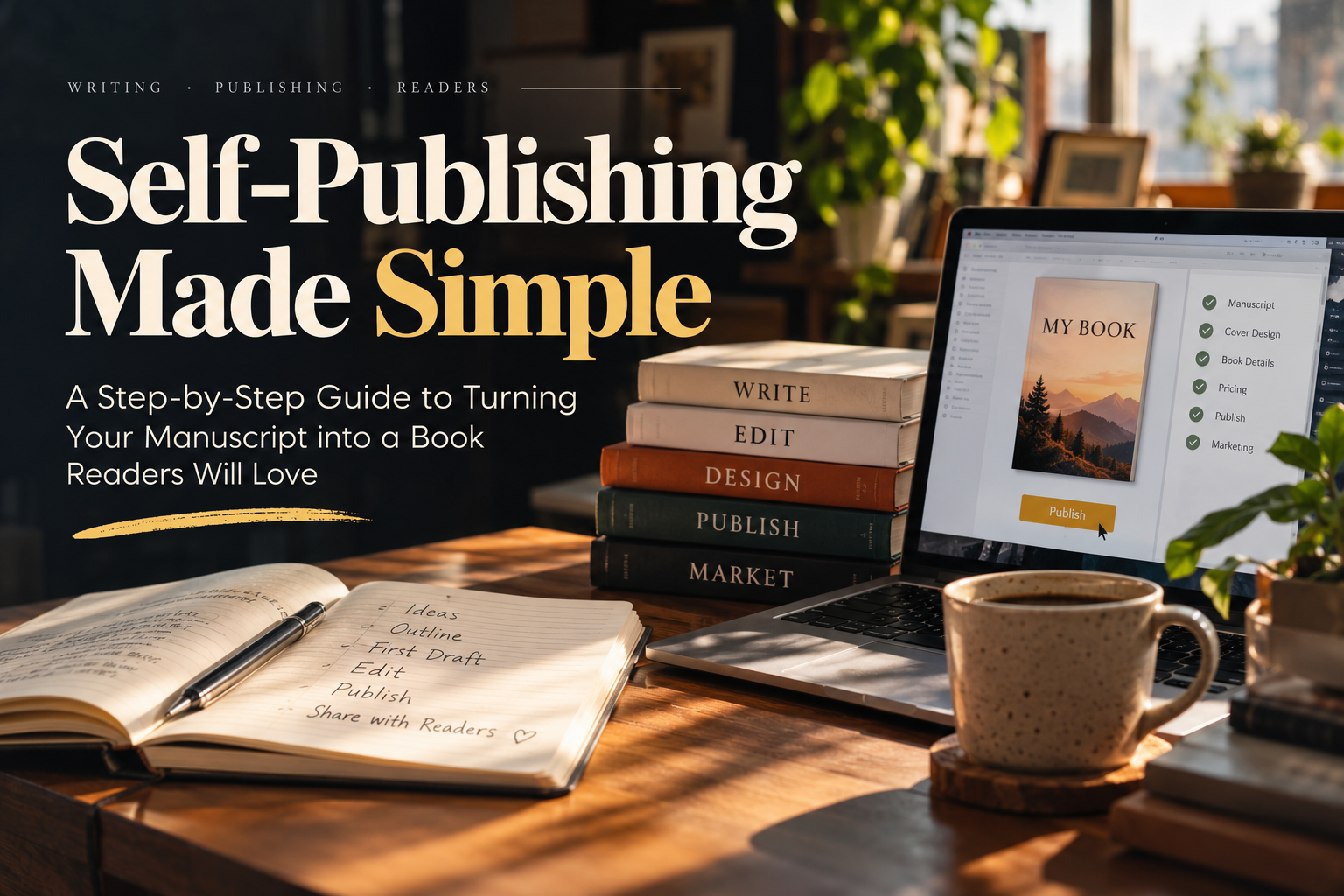
Self-publishing has transformed the way authors bring their books into the world.
Writers no longer have to wait for a literary agent or traditional publishing company to decide whether their manuscript deserves to be published. Today, authors can take control of the entire publishing process, release their books on their own schedule, reach readers around the world, and build a long-term author brand.
That freedom is one of the biggest advantages of self-publishing.
However, self-publishing also means becoming more than just a writer.
You are responsible for turning your manuscript into a professional product that readers will want to buy, read, and recommend.
The process may seem overwhelming at first, but when you break it into clear stages, self-publishing becomes much easier to manage.
What Is Self-Publishing?
Self-publishing is the process of publishing a book independently rather than working with a traditional publishing house.
Instead of a publisher controlling production, distribution, pricing, and marketing, the author takes responsibility for these decisions.
As a self-published author, you typically control:
Editing
Cover design
Interior formatting
Book pricing
Publishing platforms
Distribution
Marketing
Your release schedule
Your author brand
Platforms such as Amazon Kindle Direct Publishing, IngramSpark, Draft2Digital, and other publishing services have made independent publishing accessible to almost anyone.
However, being able to publish a book quickly does not mean you should rush the process.
Professional self-publishing still requires careful planning.
Why More Authors Are Choosing Self-Publishing
For many writers, the biggest advantage of self-publishing is creative control.
With traditional publishing, authors may have limited influence over their book cover, pricing, marketing strategy, or publication date.
Independent authors can make those decisions themselves.
Self-publishing also allows writers to move faster.
Instead of spending months or years querying agents and waiting for publishing decisions, an author can prepare and release a book according to their own schedule.
There are also financial advantages.
While self-published authors usually pay production costs themselves, they may receive a larger percentage of revenue from each book sold compared with traditional royalty structures.
Most importantly, the author remains in control of the publishing business.
Step 1: Finish and Revise Your Manuscript
The publishing process starts with the manuscript.
Before thinking about book covers, advertisements, or launch campaigns, make sure the book itself is ready.
Complete your first draft and give yourself time to revise it.
For fiction authors, this may involve reviewing:
Plot structure
Character development
Dialogue
Pacing
Continuity
Story arcs
For nonfiction authors, revision may involve improving:
Chapter organization
Arguments
Examples
Research
Clarity
Reader outcomes
One of the biggest mistakes new authors make is rushing into publication immediately after completing the first draft.
Your manuscript deserves time to develop.
Step 2: Get Your Book Professionally Edited
Editing is one of the most important stages of self-publishing.
Even experienced writers struggle to identify every problem in their own manuscripts because they have read the material so many times.
Professional editing provides an outside perspective.
Depending on your book, you may need several types of editing.
Developmental Editing
Developmental editing focuses on the big picture.
For fiction, it may examine plot, pacing, character development, structure, and storytelling.
For nonfiction, it may focus on organization, arguments, clarity, and whether the book successfully delivers its promised outcome.
Copyediting
Copyediting focuses on sentence-level improvements.
The editor may correct grammar, awkward wording, inconsistencies, punctuation, and style problems.
Proofreading
Proofreading usually takes place near the end of production.
Its purpose is to catch remaining spelling errors, formatting problems, typos, and small mistakes before publication.
Skipping professional editing may save money initially, but it can also damage the reader's experience.
Step 3: Design a Professional Book Cover
Your book cover is one of your most important marketing assets.
Before a reader knows anything about your writing, they see the cover.
A professional cover should immediately communicate the genre, tone, and intended audience of the book.
For example, a psychological thriller should not look like a lighthearted romance novel.
A business book should not look like an epic fantasy novel.
Research successful books within your genre before designing your cover.
Look for patterns in:
Typography
Photography
Illustration
Colors
Layout
Title placement
Overall mood
You do not need to copy other books.
The goal is to make sure your cover visually belongs in the same marketplace.
Also test your cover at thumbnail size.
Most readers will first encounter it as a small image on Amazon, social media, or another online bookstore.
If the title becomes unreadable when the image is small, the design may need improvement.
Step 4: Format the Interior of Your Book
Once your manuscript has been edited, it needs to be formatted.
Print books and ebooks require different formatting considerations.
For print editions, you may need to decide on:
Book dimensions
Margins
Fonts
Paragraph spacing
Chapter headings
Page numbers
Headers
Front matter
Back matter
Ebooks require flexible formatting because readers can change font sizes and screen settings.
Good book formatting should feel almost invisible.
Readers should be able to concentrate on the content without being distracted by inconsistent spacing, unusual fonts, awkward page breaks, or formatting errors.
Step 5: Choose Where to Publish Your Book
There are several ways to distribute a self-published book.
Amazon Kindle Direct Publishing is one of the most widely used platforms because it allows authors to publish ebooks and print books directly through Amazon.
However, Amazon does not have to be your only distribution channel.
Authors may also use services such as IngramSpark or Draft2Digital to reach additional bookstores, libraries, and online retailers.
You will generally need to decide whether you want to publish primarily through one platform or distribute your book widely.
The right strategy depends on:
Your target readers
Book format
Genre
Pricing strategy
Long-term publishing goals
Think about where your ideal readers already buy books.
Step 6: Write a Strong Book Description
Your book description is not simply a summary.
It is sales copy.
Its job is to make potential readers interested enough to purchase the book.
For fiction, your description should introduce the main conflict, characters, stakes, and emotional tension without giving away the ending.
For nonfiction, focus on the reader's problem and the transformation or information the book provides.
A simple structure is:
Hook → Problem → Promise → Reason to Read
Keep paragraphs relatively short.
Many readers will be viewing your book page on a smartphone, so your description should be easy to scan.
Step 7: Choose the Right Categories and Keywords
Book discoverability matters.
Online bookstores use metadata such as categories, keywords, titles, descriptions, and reader behavior to determine where books appear.
Choose categories that accurately represent your book.
A smaller but highly relevant category may be more valuable than placing your book in a broad category where it does not fit well.
You should also research keywords that potential readers may use when searching.
Depending on your book, keywords may relate to:
Genre
Tropes
Themes
Character types
Location
Reader problems
Desired outcomes
Subject matter
Focus on relevance rather than trying to include as many keywords as possible.
Step 8: Decide How to Price Your Book
Pricing can influence both sales and reader perception.
Before choosing a price, research similar books in your genre.
Compare:
Ebook prices
Paperback prices
Hardcover prices
Book length
Author experience
Genre expectations
Pricing your book significantly higher than comparable titles may discourage new readers.
Pricing it too low may reduce perceived value.
You can always experiment with promotional pricing later.
Step 9: Build Your Author Platform
One of the biggest mistakes authors make is waiting until publication day before building an audience.
Ideally, marketing begins before the book launches.
Your author platform can include:
An author website
Email newsletter
Facebook
Instagram
TikTok
YouTube
Reader communities
Podcasts
Book bloggers
Goodreads
You do not have to use every platform.
It is usually better to focus on two or three channels that you can maintain consistently.
Your content should also include more than constant book promotions.
Readers may enjoy:
Writing updates
Book excerpts
Character introductions
Reading recommendations
Behind-the-scenes content
Research stories
Personal insights
Genre discussions
Building relationships with readers is more valuable than simply collecting followers.
Step 10: Plan Your Book Launch Before Release Day
A successful launch should begin weeks before your book becomes available.
Prepare your promotional materials early.
Your launch campaign could include:
Cover reveals
Book excerpts
Author interviews
Character introductions
Countdown posts
Email announcements
Advance reader copies
Early reviews
Book trailers
Social media graphics
Giveaways
Live events
Create a simple content calendar so you know what will be published before, during, and after launch week.
Planning ahead makes your launch much easier to manage.
Step 11: Collect Reviews
Reviews provide valuable social proof.
Potential buyers often look at reviews before deciding whether to purchase an unfamiliar author's book.
Consider providing advance review copies to readers before publication.
You may reach out to:
Book bloggers
Reviewers
Newsletter subscribers
Existing readers
Genre communities
Advance reader teams
Always allow reviewers to give their genuine opinions.
The goal is to build authentic feedback, not manufacture positive reviews.
Step 12: Keep Marketing After Launch Day
Your marketing should not stop one week after publication.
A self-published book can continue generating sales for years.
Continue experimenting with different ways of introducing your book to readers.
For fiction, you might create content about:
Characters
Quotes
Tropes
Relationships
Settings
Plot themes
Reader reactions
For nonfiction, you can turn individual ideas from your book into:
Educational posts
Short videos
Articles
Newsletter content
Interviews
Social media carousels
Every book you publish can also help sell your previous books.
Over time, your catalog becomes one of your strongest marketing assets.
Common Self-Publishing Mistakes to Avoid
Self-publishing gives authors tremendous freedom, but that freedom can also make it easy to rush.
Some common mistakes include:
Publishing before the manuscript is ready
Skipping professional editing
Using an amateur-looking cover
Ignoring formatting quality
Choosing poor keywords
Targeting the wrong readers
Launching without a marketing strategy
Promoting only during launch week
Trying to do everything alone
Independent publishing does not mean you must personally handle every task.
You can remain in control while hiring editors, designers, formatters, marketers, or other specialists when needed.
How Much Does Self-Publishing Cost?
There is no single fixed cost for self-publishing.
Some authors spend very little because they handle most of the process themselves.
Others invest significantly in professional services.
Potential expenses include:
Editing
Proofreading
Cover design
Book formatting
ISBNs
Author websites
Advance copies
Advertising
Marketing software
Promotional materials
Instead of focusing only on publishing as cheaply as possible, think about where professional quality will have the greatest impact.
For many authors, editing and cover design are among the most important areas to invest in.
Is Self-Publishing Worth It?
Self-publishing can be an excellent option for writers who want more control over their books and publishing careers.
It gives authors the freedom to make creative decisions, set their own publishing schedules, experiment with marketing, communicate directly with readers, and build a catalog they control.
However, successful independent publishing requires more than uploading a manuscript.
You have to think like both an author and a publisher.
Write the strongest book you can.
Edit it carefully.
Package it professionally.
Understand your readers.
Make the book easy to discover.
And continue promoting it long after publication day.
A manuscript begins as a creative project.
Self-publishing is what transforms that manuscript into a professional book that readers can discover, purchase, enjoy, and recommend.