Developmental Editing vs. Line Editing vs. Copyediting vs. Proofreading: Which Do You Need?
Finishing a manuscript is an important milestone, but completing a draft does not necessarily mean a book is ready for publication.
Most manuscripts benefit from revision and editorial review. The challenge is understanding which kind of editing will address the problems your book actually has.
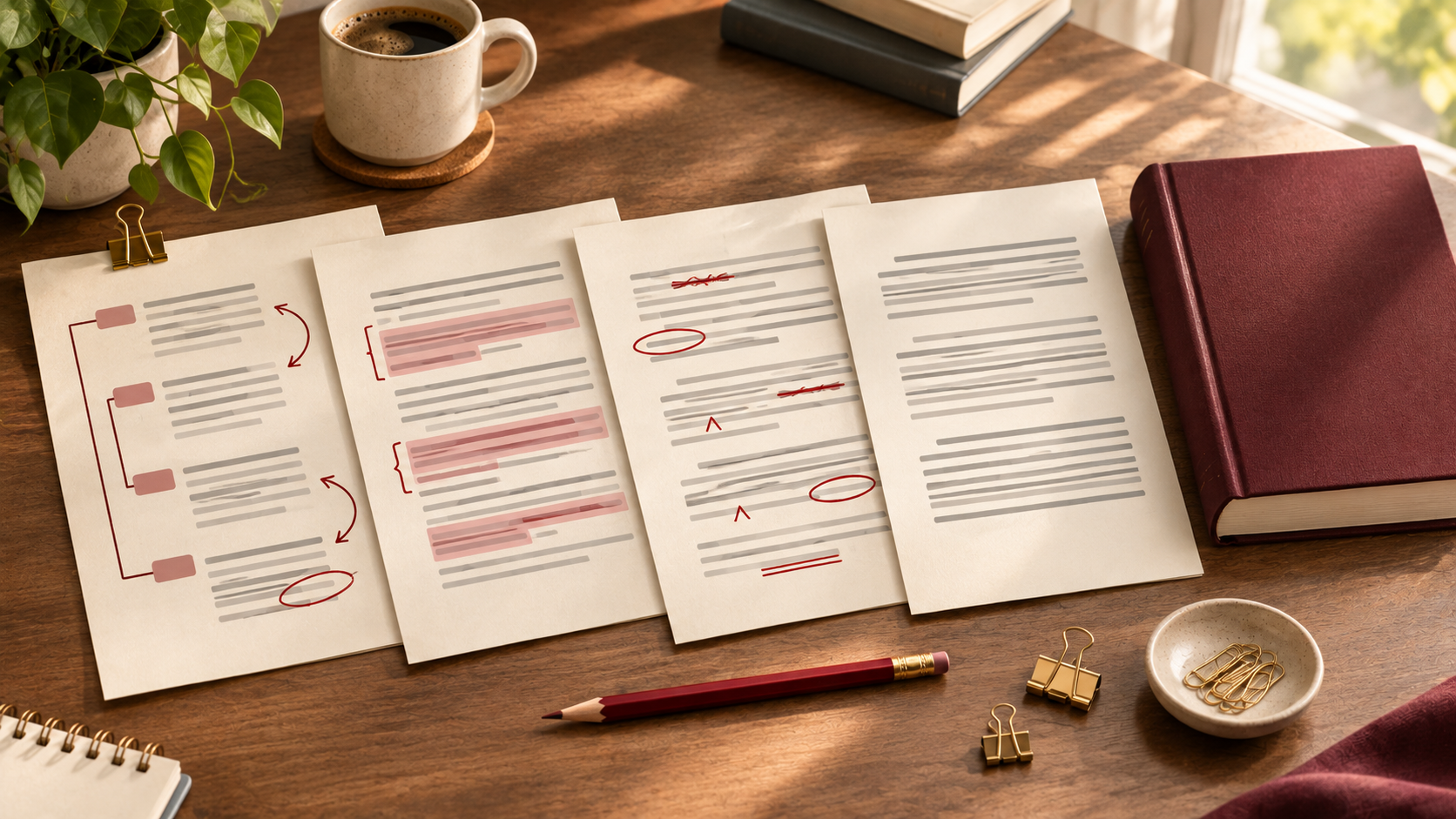
Developmental editing examines the structure and substance of a manuscript. Line editing improves the writing at the sentence and paragraph level. Copyediting addresses correctness and consistency, while proofreading checks the final formatted material for remaining errors.
These services have different purposes, and choosing the wrong one can leave important problems unresolved.
The Four Main Types of Book Editing
Editors may describe their services differently, but the following distinctions provide a useful starting point.
| Editing Type | Primary Focus | Best Used When |
|---|---|---|
| Developmental editing | Structure, content, narrative effectiveness | The manuscript needs major improvements |
| Line editing | Style, clarity, flow, voice | The structure is sound but prose needs refinement |
| Copyediting | Grammar, punctuation, consistency, accuracy | The content and prose are largely finalized |
| Proofreading | Remaining errors in formatted material | The book is nearly ready for publication |
These boundaries are not universal. Some editors combine services or use different terminology.
The Editors Canada definitions of editorial skills distinguish structural, stylistic, copyediting, and proofreading work while acknowledging overlap in professional usage.
What Is Developmental Editing?
Developmental editing focuses on how well the manuscript works as a complete book.
For fiction, a developmental editor may evaluate plot structure, character motivation, pacing, conflict, point of view, and the relationship between major scenes.
For nonfiction, the editor may examine the argument, chapter organization, intended audience, completeness, and effectiveness of examples.
A developmental editor might identify a weak middle section, suggest reordering chapters, or explain why an important character decision feels unconvincing.
The work may be delivered through an editorial letter, manuscript comments, or a combination of both.
When Do You Need Developmental Editing?
Consider this service if:
Readers struggle to understand the central story or argument.
Major sections feel disconnected.
Character motivations or plot developments lack credibility.
The manuscript contains substantial repetition.
You are unsure whether the book achieves its intended purpose.
Developmental editing generally happens before detailed sentence-level polishing.
There is little value in perfecting a passage that later needs to be removed.
What Is Line Editing?
Line editing focuses on how the writing communicates meaning.
A line editor considers sentence structure, rhythm, word choice, clarity, transitions, and voice.
The goal is not necessarily to make every sentence shorter or simpler. It is to make the prose serve the book more effectively.
Consider this illustrative sentence:
She walked very slowly across the room because she was feeling an overwhelming sense of fear.
A tighter version might be:
She crossed the room slowly, afraid of what waited beyond the door.
The revision changes the rhythm and introduces a more specific emotional situation.
However, a good line editor should not automatically replace an author's style with a preferred formula.
When Do You Need Line Editing?
Line editing may be useful when the overall manuscript works but individual passages feel awkward, repetitive, confusing, or inconsistent in tone.
It can be particularly valuable when the author's voice is central to the reading experience.
What Is Copyediting?
Copyediting focuses on correctness, consistency, and editorial detail.
A copyeditor reviews grammar, spelling, punctuation, capitalization, and usage.
The service may also address continuity, terminology, factual queries, and style consistency within the agreed scope.
For example, a copyeditor might notice that a character's surname changes between chapters or that a nonfiction manuscript uses inconsistent terminology.
Copyeditors may create a style sheet recording decisions about spelling, capitalization, names, and other conventions.
A style sheet helps preserve consistency across the book.
Does Copyediting Include Fact-Checking?
Not automatically.
Copyeditors may flag questionable statements or inconsistencies, but comprehensive research and fact-checking should be discussed as separate scope requirements when necessary.
Authors should clarify this before hiring.
What Is Proofreading?
Proofreading is the final quality-control stage.
It generally takes place after the manuscript has been edited and laid out or converted into its publication format.
A proofreader checks for remaining textual and layout errors, such as misspellings, incorrect page references, inconsistent headings, or formatting problems.
Proofreading does not replace developmental editing or copyediting.
A proofreader may flag a major problem if one is discovered, but restructuring an entire chapter is not normally part of the service.
What Order Should Book Editing Follow?
For manuscripts requiring all four services, a typical sequence is:
Author revision: Address major problems identified during self-review.
Developmental editing: Evaluate and improve the manuscript's structure and substance.
Line editing: Refine clarity, style, flow, and voice.
Copyediting: Correct mechanical and consistency issues.
Formatting and layout: Prepare the publication files.
Proofreading: Check the final formatted material.
This is a workflow, not a universal requirement.
Some manuscripts need only selected stages. Some editors combine line editing and copyediting.
The right process depends on the manuscript's condition and the publishing team's responsibilities.
How to Choose the Right Editing Service
Start by identifying your manuscript's biggest unresolved problem.
If your novel's plot is still changing, prioritize developmental feedback.
If your nonfiction book has a strong structure but unclear explanations, line editing may be helpful.
If the content is finalized and the prose is ready, copyediting becomes more appropriate.
If the book is already formatted, proofreading helps identify remaining production errors.
When uncertain, ask an editor for a manuscript assessment or sample edit.
Questions to Ask Before Hiring an Editor
Clarify the actual services included in the quote.
Ask whether the editor works in your genre, what deliverables you will receive, how many passes are included, and whether questions or follow-up discussions are covered.
You should also discuss:
Manuscript length and condition.
The expected schedule.
Editing software and file formats.
Whether revisions are tracked.
Payment terms and cancellation conditions.
Any separate fact-checking requirements.
An editor's job description matters more than the label on the service.
Can You Skip an Editing Stage?
Some authors have limited budgets and need to prioritize.
A thorough self-revision can reduce the amount of work an editor needs to perform, but it cannot guarantee that all problems have been identified.
Beta readers may help reveal confusing passages or weak character motivations, but their feedback is not a direct replacement for professional editorial services.
If you cannot afford every stage, address the most serious problems first.
For example, spending your available budget on proofreading alone will not resolve a manuscript with major structural weaknesses.
Final Thoughts
Every editing stage answers a different question.
Developmental editing asks whether the book works. Line editing asks whether the writing communicates effectively. Copyediting checks correctness and consistency. Proofreading examines the final publication for remaining errors.
Before hiring, evaluate your manuscript honestly and request a clearly defined scope of work.
The right editorial support should improve the reading experience while preserving the author's intended voice.
Reference: Editors Canada — Definitions of Editorial Skills.